
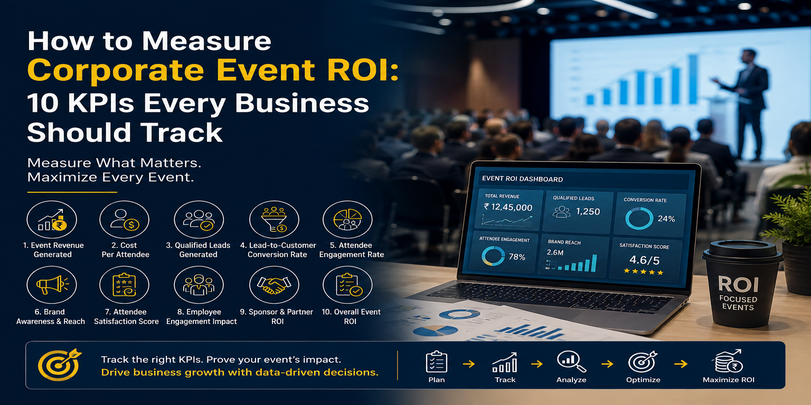
Corporate events are no longer measured only by attendance, venue quality, or how smoothly the programme runs. Businesses increasingly need to understand whether an event contributed to measurable outcomes such as lead generation, employee engagement, brand visibility, client relationships, sales opportunities, and business growth. This guide explains how to measure Corporate Event ROI using 10 practical Corporate event KPI metrics, with a focus on conferences, product launches, corporate summits, award nights, team-building events, and brand activations.
For companies planning large-scale business events, the right measurement framework should begin before the event and continue after it ends. SnowBubble Events, for example, delivers corporate events, conferences, product launches, summits, workshops, team-building activities, sales meetups and brand activations, with more than 650 events delivered, 13+ years of experience, 2M+ attendees engaged and 200+ corporate clients.
What Is Corporate Event ROI?
Corporate Event ROI measures the business value generated by an event compared with the investment made to deliver it.
A simple ROI calculation is:
Corporate Event ROI = (Business Value Generated − Total Event Investment) ÷ Total Event Investment × 100
However, event performance cannot always be represented by immediate revenue. A conference may generate qualified leads, while an employee event may improve engagement and retention. A product launch may create awareness and sales opportunities that convert several months later.
That is why businesses should combine financial measurements with engagement, marketing and relationship-based KPIs.
10 Corporate Event KPIs Every Business Should Track
1. Event Revenue Generated
For sales-focused events, revenue is one of the clearest indicators of event performance.
Track:
- Sales generated during the event
- Revenue attributed to event leads
- New customer purchases
- Upsell or cross-sell opportunities
- Revenue generated within a defined post-event period
For a product launch or dealer meet, compare event-generated revenue with the total event investment to understand commercial performance.
2. Cost Per Attendee
Cost per attendee helps businesses understand whether the event budget was efficiently allocated.
Formula:
Total Event Cost ÷ Number of Attendees = Cost Per Attendee
Do not use this KPI in isolation. A premium corporate conference with senior decision-makers may have a higher cost per attendee but generate substantially greater business value than a low-cost gathering.
3. Qualified Leads Generated
Lead generation is particularly important for conferences, exhibitions, product launches and corporate networking events.
Track:
- Total leads collected
- Marketing-qualified leads
- Sales-qualified leads
- Decision-makers engaged
- Follow-up meetings booked
- Leads converted into opportunities
A registration number alone does not tell you whether an event delivered commercial value. Lead quality provides a much clearer picture.
4. Lead-to-Customer Conversion Rate
After collecting leads, measure how many eventually become customers.
Formula:
Converted Leads ÷ Qualified Leads × 100
Set a defined tracking period—for example, 30, 60 or 90 days after the event—depending on the sales cycle.
This is especially useful for B2B events where purchasing decisions may involve several meetings before conversion.
5. Attendee Engagement Rate
Attendance is only the starting point. Engagement shows whether participants actually interacted with the event.
Useful indicators include:
- Session participation
- Live poll responses
- Q&A participation
- Networking activity
- Workshop participation
- Product demonstrations attended
- Social media interactions
For conferences and summits, session-level engagement can help identify which formats and topics generated the strongest response.
6. Brand Awareness and Reach
Brand-focused events should measure visibility beyond the physical venue.
Track:
- Social media mentions
- Event hashtag usage
- Content impressions
- Website traffic during and after the event
- Branded searches
- Media coverage
- New social followers
- Video views
For product launches and brand activations, compare pre-event and post-event brand metrics wherever reliable data is available.
7. Attendee Satisfaction Score
An event can generate strong attendance while still leaving participants dissatisfied.
Use a short post-event survey to measure:
- Overall satisfaction
- Venue experience
- Content quality
- Speaker performance
- Registration experience
- Hospitality
- Event production
- Likelihood of recommending the event
A simple 1–5 rating system makes results easy to compare across events.
8. Employee Engagement Impact
For internal corporate events, the definition of ROI changes.
Team-building programmes, annual celebrations, sales meets and employee conferences can be evaluated through:
- Participation rate
- Employee feedback
- Team collaboration scores
- Post-event engagement
- Internal communication activity
- Employee retention indicators
The objective is not simply to organise an enjoyable gathering. The event should support a clearly defined business or people-related goal.
9. Budget Variance
Even an event that performs well commercially can become inefficient if spending is poorly controlled.
Formula:
Budget Variance = Actual Event Cost − Approved Event Budget
Monitor major categories such as:
- Venue
- Production
- AV and technical requirements
- Décor
- Catering
- Entertainment
- Guest management
- Travel and accommodation
- Branding and activation
Professional event planning requires structured budget monitoring from the initial planning stage through final settlement.
10. Overall Business Value
The final Corporate Event ROI assessment should bring multiple results together.
Create a scorecard combining:
- Revenue
- Qualified leads
- Conversion opportunities
- Audience engagement
- Brand reach
- Attendee satisfaction
- Employee engagement
- Budget performance
- New business relationships
- Post-event opportunities
This prevents decision-makers from judging an event on a single number.
How to Measure Corporate Event ROI Before, During and After the Event
The strongest measurement process starts before guests arrive.
Before the Event
Define:
- Primary business objective
- Target audience
- Expected attendance
- Lead target
- Engagement target
- Revenue target
- Maximum budget
- Measurement period
For example, a product launch could target 300 qualified business attendees, 50 sales meetings and a defined number of post-event opportunities.
During the Event
Use registration data, attendance tracking, engagement tools and lead collection systems to capture real-time performance.
Your event team should monitor participation and operational performance rather than waiting until the event is finished.
After the Event
Within the first few days, consolidate attendance, engagement and satisfaction data. Then continue tracking leads, meetings and conversions over the agreed sales cycle.
This is where many businesses make a mistake: they evaluate an event immediately after the venue closes, even though the commercial impact may develop weeks or months later.
Why Professional Corporate Event Management Matters
Measuring ROI becomes easier when event planning, production, attendee management and business objectives are connected from the beginning.
SnowBubble Events positions its corporate event services around conferences, summits, product launches, award launches and brand activations. Its website also highlights an ROI-focused approach and showcases corporate work including the Global Investors Conference, SBI Life Insurance awards and musical night, WIRC regional conference, Marcura annual carnival and AISTA’s Sugar and Bioenergy Conclave.
For businesses, the practical lesson is simple: define the expected outcome before selecting the event format, venue, production scope and engagement activities.
Final Takeaway
A successful corporate event should create measurable business value—not just a memorable day.
By tracking the right Corporate event KPI metrics, businesses can understand which events generate revenue, qualified opportunities, stronger relationships, employee engagement and brand visibility. The most effective Corporate Event ROI strategy combines financial results with meaningful engagement and long-term business outcomes.
When planning your next conference, product launch, summit, award night or corporate gathering, establish the KPIs before the event begins. That gives your team a clear benchmark for measuring performance and making smarter decisions about future events.
Frequently Asked Questions
1. What is the most important KPI for Corporate Event ROI?
There is no single KPI that works for every event. Revenue and qualified leads are important for sales-driven events, while engagement, satisfaction and employee participation may matter more for internal corporate programmes.
2. How do you calculate Corporate Event ROI?
Use the formula: (Business Value Generated − Total Event Investment) ÷ Total Event Investment × 100. For a complete assessment, combine financial results with lead generation, engagement, brand and satisfaction metrics.
3. Which Corporate event KPI should be tracked after the event?
Lead conversion, revenue attribution, attendee satisfaction, website traffic, social engagement and follow-up meetings should be monitored after the event because many business outcomes occur later.
4. How can businesses measure event success without immediate sales?
Track qualified leads, networking outcomes, audience engagement, brand reach, attendee satisfaction, product interest and scheduled follow-up meetings. These indicators can demonstrate value before revenue is realised.
5. Why is pre-event KPI planning important?
Pre-event KPI planning establishes measurable targets for attendance, leads, engagement, revenue, budget and business outcomes. It also makes post-event analysis more objective and helps businesses improve future corporate events.
