
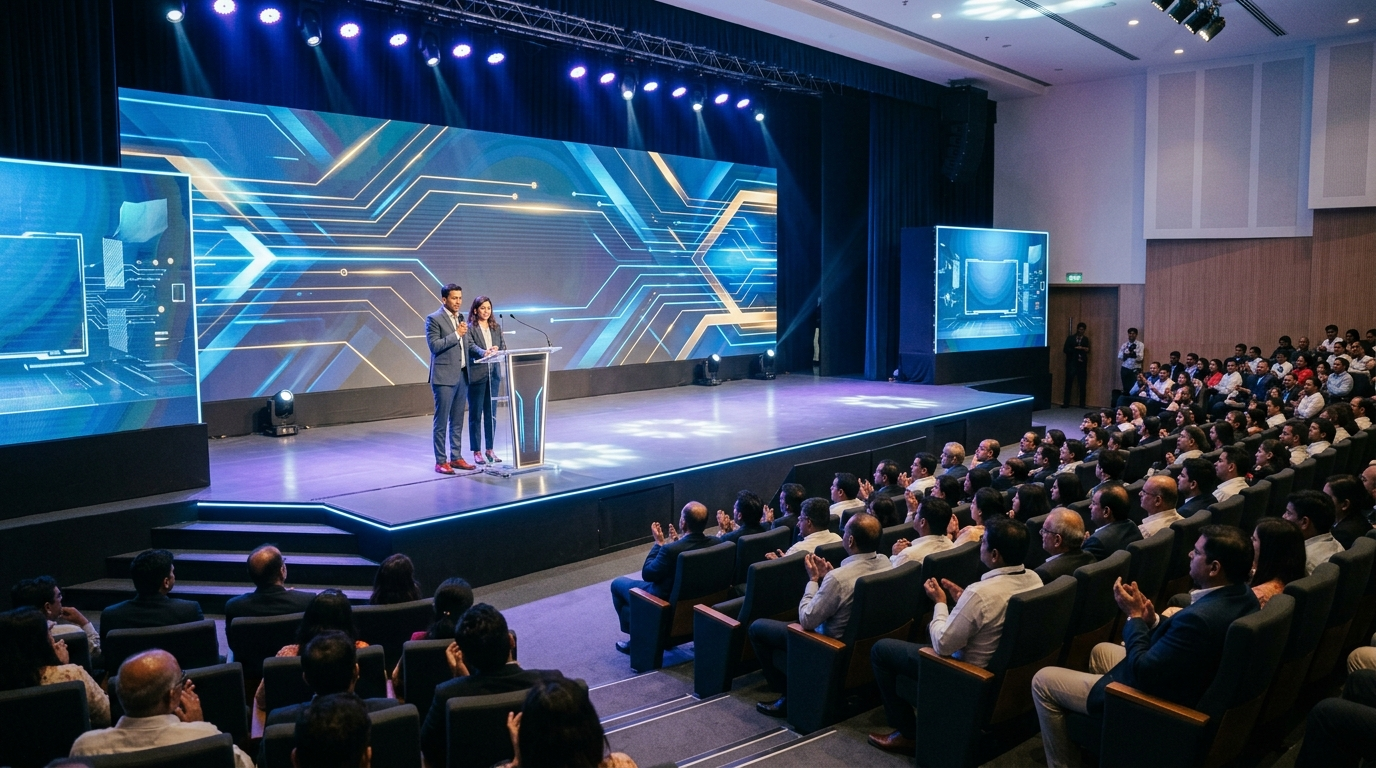
Executing a high-stakes B2B product launch requires a synchronised event production framework that aligns technical AV architecture, Run-of-Show (ROS) timing, media logistics, and spatial design with core corporate conversion metrics. Executing a successful product launch depends on controlling critical operational variables—from stage load-in cadences and DMX lighting protocols to registration throughput—to eliminate brand risk and ensure maximum audience engagement.
Key Takeaways for Event Stakeholders
- For Corporate & HR Executives Mitigate execution risk and guarantee measurable ROI through unified vendor management, fixed contingency buffers, and strict compliance with venue safety and power load allocations.
- For Marketing & Brand Directors: Elevate brand perception and drive media amplification using 3D spatial floor planning, DMX-controlled intelligent lighting, and zero-latency AV synchronization tailored for viral press coverage.
B2B Product Launch Execution Matrix
|
Metric |
DIY / In-House Launch Execution |
Standard Event Management |
Snow Bubble Events Bespoke Managed Production |
|
Operational Scope |
Decentralized internal coordination; fragmented execution across PR, HR, and marketing teams. |
Generic template-based coordination with third-party sub-contractors. |
End-to-end event engineering, custom stage fabrication, and full-spectrum technical production management. |
|
Vendor Oversight & Contingency |
Direct liaison with individual vendors; zero real-time technical redundancy or failovers. |
Standard vendor dispatch with basic on-site supervision; limited backup AV protocols. |
Single point of contact managing audited technical partners, redundant power generators, and secondary signal paths. |
|
Guest Experience Score |
High risk of bottlenecked registration, poor sightlines, and inconsistent F&B staging. |
Standard corporate seating with off-the-shelf staging and ambient audio setups. |
Fully immersive experiential design, high-throughput digital check-in, and spatial acoustic alignment. |
|
Execution Risk |
High: Power draw overloads, ROS delays, audio feedback, and uncoordinated media streams. |
Moderate: Latency in stage transitions, basic light leakage, and potential media queuing delays. |
Low/Zero: ISO-aligned safety compliance, precise ROS synchronization, and pre-calibrated AV load-in tests. |
1. Pre-Production Engineering & Feasibility (T-12 to T-8 Weeks)
Successful product launch events originate in rigorous pre-production planning long before physical stage elements arrive on site. Establishing structural parameters during early planning stages prevents costly last-minute spatial or technical adjustments during venue load-in.
Spatial Acoustics and 3D CAD Floor Planning
Initial venue evaluation requires comprehensive 3D CAD modeling to verify sightlines, stage proportions, and guest movement corridors. Acoustic modeling must account for hard surfaces, ceiling heights, and room reverberation times to avoid sound distortion during keynote presentations.
- Map speaker array positioning using 3D CAD models to deliver uniform decibel distribution across all seating tiers without audio bleed.
- Design dual-aisle access channels to handle peak movement transitions between main keynotes, breakout zones, and live demonstration areas.
- Conduct structural load checks on overhead rigging points to safely support truss systems, LED walls, and heavy lighting rigs.
Power Telemetry and Venue Utility Audits
Unintended power trips during a high-profile reveal ruin brand impact and interrupt live press streams. Conducting a comprehensive power assessment ensures line stability for high-draw hardware, heavy lighting rigs, and broadcast truck hookups.
- Calculate cumulative wattage demands across audio, visual, lighting, and HVAC systems to avoid overloading standard venue breakers.
- Secure dedicated clean power lines isolated from heavy machinery or catering elements to eliminate electrical hum in live audio feeds.
- Integrate redundant, auto-switching diesel generator setups to guarantee uninterrupted operation during unexpected grid drops.
2. Technical AV Infrastructure & Stage Integration (T-8 to T-2 Weeks)
The impact of a product reveal relies on precise synchronization between audio systems, dynamic lighting sequences, and visual media displays. Technical infrastructure must be designed with redundant signal paths to handle live broadcast and press feeds reliably.
DMX-Controlled Intelligent Lighting & Visual Staging
Lighting designs should guide audience focus, highlight key product features, and maintain color accuracy for video coverage. Using DMX-512 protocols enables precise, frame-accurate cues synchronized with product launch audio tracks and backdrop reveals.
- Position high-CRI key lights to preserve accurate color rendition on stage and keep presenter faces shadow-free for broadcast cameras.
- Program automated DMX lighting cues mapped to media playback to emphasize peak reveal moments with sharp focus shifts.
- Use ultra-high-definition, fine-pixel pitch LED screens to deliver crisp graphics without moiré patterns on live media cameras.
Dante Networked Audio Architecture
Audio setups must ensure high speech intelligibility for keynote presenters while delivering dynamic range for impactful media content. Networked audio backbones like Dante offer lossless signal routing over IP, allowing seamless real-time management of wireless channels and broadcast splits.
- Deploy multi-channel wireless mic arrays with active spectrum scanning to automatically avoid local radio frequency interference.
- Implement Dante-networked digital audio routing with automated failover paths to instantly switch to backup mics if needed.
- Balance spatial sound zones to deliver clear, comfortable audio across front-row press sections and main corporate seating areas alike.
3. Run-of-Show (ROS) Synchronization & Media Logistics (T-1 Week to T-48 Hours)
A seamless Run-of-Show (ROS) depends on clear communication between stage managers, technical directors, talent handlers, and media production crews. Minute-by-minute scheduling keeps stage sequences running on time and maintains audience engagement throughout the event.
Cue-to-Cue Alignment & Rehearsal Protocols
A full cue-to-cue rehearsal validates timing between spoken keynotes, media server video cues, stage automation, and pyrotechnic or mechanical reveals. On-stage talent must practice with production-grade teleprompters, wireless ear monitors, and precise stage positioning indicators.
- Conduct a full dry run with all video, lighting, and audio elements to fine-tune transition timings and media playback.
- Create a master Run-of-Show (ROS) document detailing timecodes, stage cues, lighting states, and audio tracks for every production crew member.
- Assign dedicated talent handlers to manage speaker timing, backstage preparation, and seamless stage handoffs without delays.
Media Routing & Press Feed Management
Managing press attendance requires specialized media infrastructure, including isolated audio feeds, dedicated high-speed internet connections, and dedicated camera platforms. Providing clear technical feeds allows journalists to broadcast content quickly without disrupting on-site guest experiences.
- Install opto-isolated press mult-boxes to provide clean, direct audio signals to broadcast media crews without ground-loop noise.
- Establish dedicated, symmetrical gigabit Wi-Fi networks reserved exclusively for media uploads, press filing, and live streaming.
- Designate elevated, stabilized media platforms positioned along the center camera line to secure clear, unobstructed sightlines to the main stage.
4. Experiential Layout, Flow & Operations (Event Day)
On event day, operational efficiency ensures a smooth experience for high-net-worth individuals, enterprise clients, and media partners. Managing guest movement and staging interactive demo areas helps maintain engagement from arrival to departure.
High-Throughput Registration & Security Management
Arrival bottlenecks immediately compromise guest satisfaction and stall event timelines. Deploying digital check-in tools and clear entry channels helps maintain high throughput during peak arrival windows.
- Deploy QR-code badge printing stations capable of completing guest check-ins in under five seconds to prevent lobby queues.
- Set up separate entry lanes for VIPs, general attendees, and accredited media to streamline security checks and credential verification.
- Utilize real-time attendee tracking software to monitor hall capacity limits and manage crowd density across different event zones.
Interactive Demonstration Zones & F&B Catering Planning
The product experience extends beyond the main keynote into hands-on demonstration spaces. Interactive areas should feature optimized floor layouts, isolated power circuits, and strategically timed catering setups to keep guest flow moving smoothly.
- Configure demo stations with localized directional speakers so attendees can hear product presentations clearly without elevated ambient noise.
- Plan food and beverage service ratios—such as tray-passed hors d'oeuvres and strategically placed cocktail stations—to encourage movement and prevent congestion around demo bays.
- Station technical specialists at each demo point to handle live hardware questions and address any unexpected technical issues immediately.
Partnering with Snow Bubble Events
Executing a flawless B2B product launch requires experienced management that bridges creative visual design with rigorous technical production. Snow Bubble Events delivers end-to-end event engineering, custom stage fabrication, and full-spectrum production management for enterprise brands and high-profile launches.
From spatial CAD modeling and power load balancing to dynamic stage management and flawless Run-of-Show execution, our team mitigates operational risk to ensure your product launch makes a lasting impact.
Explore Our Corporate Event Management Portfolio or Schedule a Custom Event Engineering Consultation to discuss your upcoming launch.
Frequently Asked Questions (FAQs)
How early should a B2B brand start planning a major product launch event?
For enterprise-level product launches, pre-production planning should ideally begin 8 to 12 weeks prior to the event date. This timeline permits complete 3D CAD spatial design, venue utility assessments, custom staging fabrication, and precise AV infrastructure routing without incurring rush procurement fees.
What power infrastructure considerations are necessary for high-tech product launches?
High-tech product reveals require dedicated clean power lines isolated from catering equipment or venue HVAC units to eliminate electrical interference. A full telemetry audit measures total wattage demands for LED walls, DMX lighting, and media servers, while redundant diesel generators provide continuous failover capability.
How does Snow Bubble Events ensure audio clarity in acoustically challenging venues?
We conduct advance acoustic evaluations and use 3D spatial sound modeling to design line-array speaker setups tailored to room geometry. By managing speaker positioning and utilizing digital Dante network routing, sound distribution remains consistent across all seating sections without unwanted distortion or echo.
What protocols prevent registration bottlenecks during peak arrival times?
High-throughput event entry relies on pre-issued QR-code digital credentials, dedicated check-in lanes, and fast badge-printing hardware. Segmenting arrival points for general attendees, media, and VIPs prevents registration congestion and ensures the event schedule stays on track.
How are unexpected AV or hardware failures handled during live product reveals?
Our technical teams build redundancy into every core production system. This includes secondary Dante audio signal paths, dual-plugged media servers with automatic failover triggers, and backup radio-frequency microphone channels scanned for real-time channel availability throughout the event.
